Is Back or Sciatic Pain Preventing You from reaching Your Exercise Goals?

We all know the importance of exercise, fitness, and generally staying active in order to age well. For many, exercise and fitness is a way to have fun and stay in shape. Others use activity to manage stress or chronic illnesses (such as diabetes, osteoporosis or heart disease). The benefit of consistent exercise has a positive effect on our physical, mental, and social well-being. It can be very disappointing when low back or sciatic pain prevents you from reaching your exercise goals.

Low back pain (LBP) or sciatic pain is the most common injury/pain complaint for those in the western world. LBP is estimated to affect nearly 80% of the U.S. population at one time or another. Worse yet, once you have experienced an episode of LBP you have a 90% chance of having a reoccurrence.

How can you address your back or sciatic pain in order to get back to doing the activity that you love (whether that is walking, running, or hitting the gym)? First, you need to assess your risk factors.

Risk Factors for Low Back Pain (LBP) or Sciatic Pain:

  • Sitting too much.
  • Slouched sitting.
  • Prior episodes of LBP.
  • Smoking.
  • Poor core and back extensor muscle strength.
  • Lack of a proper warm up and a cool down.
  • High training volumes with inadequate rest (overtraining syndrome).

Some of the specific risk factors for LBP are also risk factors for other types of injury. Lack of adequate core strength (particularly, strength in the outer core and pelvic/hip musculature) can contribute to other types of injuries, so it’s an important to address the weakness sooner rather than later.

Consider the amount of repetitive force your body must absorb even with walking (not to mention during sports or exercise). The outer core muscles are responsible for movement of the trunk and spine as well as aiding in stability. (Although critical for stability, the inner core muscles don’t actually produce any trunk or spine movement.)

The outer core muscles consists of the following muscles: lumbar paraspinal muscles; the quadratus lumborm; the internal and external obliques; and the psoas major and minor (hip flexors). Some may also include the glutes (buttocks muscles), hamstrings, and quadriceps as part of the outer core muscles.

Imbalances or a lack of strength within the core musculature often will manifest in altered lower body mechanics and an inability for the body to properly absorb and distribute forces. Over time, the body’s tissues eventually break down and can lead to a repetitive use injury in the lower extremity.

As a physical therapist, I always assess the core and hip musculature and look for imbalances in strength when determining the root cause of low back or sciatic pain. In the majority of cases, I find that a component of hip and core muscle weakness has led to the pain.

The good news is that this is a completely preventable problem. Most of us already know that we need to cross train and that proper core strength is important. However, too many of us either don’t dedicate enough time to the process or we aren’t performing the correct exercises. Performing proper core exercises and particularly, lumbar stabilization exercises are the primary treatment modality for low back pain (LBP).

Proper core and lumbar extensor strength is the key to preventing an episode of LBP and is also a critical step in avoiding other types of injuries affected by weakness in the core and pelvic/hip muscles. The most important factor in meeting your exercise goals is to be consistent. Don’t let low back or sciatic pain prevent you from staying active and enjoying your favorite activities.

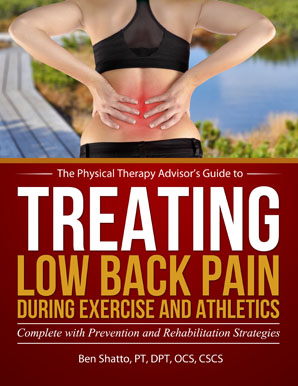
Treatment for back or sciatic pain doesn’t have to include addicting medications, scary injections, surgery or high medical bills. For the approximate price of just one co-pay to see a doctor, you will receive my easy to read book with step-by-step instructions and a complete video package designed to help you prevent and self-treat reoccurring low back pain episodes.

The Treating Low Back Pain (LBP) during Exercise and Athletics Book and Video Package includes:
AVAILABLE NOW ON AMAZON!

Treating Low Back Pain during Exercise and Athletics eBook

In this eBook, you’ll learn why it is critically important to prevent the first episode of low back pain. LBP has reoccurrence rates as high as 90%. If you have already experienced an episode of LBP, you’ll learn why exercise is an important component to long term management. Most importantly, you will understand how to avoid pain and injury in order to take your training to the next level. Topics include:

  • Specific strategies for LBP prevention.
  • How to address specific causes of LBP.
  • Best practices on how to prevent and self-treat when you experience an episode of LBP.
  • A step-by-step LBP rehabilitation guide complete with photos and detailed exercise descriptions.
  • How to implement prevention and rehabilitation strategies.

 7-part Series of Instructional Videos

Nearly 60 minutes of actionable advice to prevent and treat LBP as it relates to active individuals, sports, and athletics. An in-depth look at treating LBP with a 7-part series of instructional videos in which I address the following:

  • Potential Risk Factors for Lower Back Pain
  • What are the Core Muscles?
  • Prevention during Exercise (Part 1 and 2)
  • Initial Treatment
  • Further Treatment and Taping
  • Long Term Management Strategies and Final Recap

Save 15% with discount code LBP

“As a long time back pain sufferer I can honestly say I’ve tried it all. True LBP will make you desperate enough to try anything. Long story short – Ben Shatto truly rescued me from this vicious pain cycle. Ben’s methods of physical therapy whether it’s hands on treatment or this amazing video packet, his methods prove to be cutting edge and highly effective. Healing takes work and this video package is a fantastic foundation for the healing process to ignite!” –Sandy

When Can I Return to Exercise after having Low Back or Sciatic Pain?

“When can I return to my normal activity after experiencing an episode of severe low back or sciatic pain?” is a question I am often asked as a physical therapist. Low back pain (LBP) and sciatic pain can be so severe and debilitating that it can completely derailing your training and lifestyle! It’s hard to run, exercise or even move if your back, buttocks or leg hurts.

Believe it or not, in spite of what your back or sciatic pain is telling you, initial activity and exercise are a critical component to treatment and recovery and is backed by extensive scientific research. 

Everyone’s experience with low back or sciatic pain is different. The severity of pain can widely vary. For some, even walking normally can be difficult. A guide for which exercises and movements to perform is critical in order to successfully return to activity.

One crucial indicator that you’re ready to taper back into more regular activity (as you progress your rehabilitation-based exercise) is whether or not you can walk with a normal gait. In particular, can you walk normally with a longer stride length during your normal gait cycle?

The ability to walk normally (notice that I didn’t say without discomfort) is an important milestone. It means that the spine is being stabilized well enough from the core musculature and that the nerves in the leg are not too tight or inflamed to tolerate and accommodate for the stretch that will occur from other activities.

If you are unable to walk normally, then the emphasis should be on regaining lumbar and lower extremity range of motion in addition to performing core and lumbar stabilization exercises. Limit your sitting, but do not try to taper back into other activities (at least not yet).

It’s critical to remember that everyone’s recovery will be different. Recovery and tapering back into your normal activities should be entirely symptom dependent. Listen to your body on what it can handle. The pain will tell you if you need to stop.

When to Return to Exercise after having Low Back or Sciatic Pain:

Follow the rule of thumb for movement: If the pain worsens by spreading peripherally down the buttock and into the leg and/or foot, then the condition is worsening. You must stop that activity. If the pain centralizes and returns back toward the spine (even if the pain worsens slightly), then keep moving as the condition is actually improving.

  • Don’t resume your running, jogging or other training activities until you can walk normally at a quick pace.
  • Be sure to slowly taper back into your training as your back begins to feel better. Don’t quickly resume your prior training volume. Instead, taper back up.
  • Prior to activity and training, perform a very thorough warm up (including press-ups, superman exercises, and bridging). Then transition into an activity specific warm up.
  • Continue with a core and lumbar strengthening program at least until you resume your full volume of training.

Prior to returning to your full and normal training activities, insure the following:

  • Complete lumbar mobility has returned.
  • You no longer have sensations, weakness or instability within the spine.
  • If you experienced leg pain, your involved leg is as flexible as the other. The pain is now either gone or centralized (meaning that you’re not experiencing pain in the leg).
  • Your hip mobility on both sides is equal.
  • Your involved leg is as strong as the other leg, particularly hip abduction (glutes medius) and the hip external rotators. Test this by jumping up and down on one leg. Do you feel strong? Is there pain associated with this? If the strength isn’t there or the pain remains, you are not ready to taper up to full training activities.
  • You can jog, run, sprint, and jump without pain.

With proper treatment, low back or sciatic pain should resolve in as quickly as two weeks. Severe episodes can take 4-6 weeks or longer. Continue with your rehabilitation protocol until you’re performing all exercises normally.

Treatment for back or sciatic pain doesn’t have to include addicting medications, scary injections, surgery or high medical bills. For the approximate price of just one co-pay to see a doctor, you will receive my easy to read book with step-by-step instructions and a complete video package designed to help you prevent and self-treat reoccurring low back pain episodes.

The Treating Low Back Pain (LBP) during Exercise and Athletics Book and Video Package includes:

AVAILABLE NOW ON AMAZON!

Treating Low Back Pain during Exercise and Athletics eBook

In this eBook, you’ll learn why it is critically important to prevent the first episode of low back pain. LBP has reoccurrence rates as high as 90%. If you have already experienced an episode of LBP, you’ll learn why exercise is an important component to long term management. Most importantly, you will understand how to avoid pain and injury in order to take your training to the next level. Topics include:

  • Specific strategies for LBP prevention.
  • How to address specific causes of LBP.
  • Best practices on how to prevent and self-treat when you experience an episode of LBP.
  • A step-by-step LBP rehabilitation guide complete with photos and detailed exercise descriptions.
  • How to implement prevention and rehabilitation strategies. 

7-part Series of Instructional Videos

Nearly 60 minutes of actionable advice to prevent and treat LBP as it relates to active individuals, sports, and athletics. An in-depth look at treating LBP with a 7-part series of instructional videos in which I address the following:

  • Potential Risk Factors for Lower Back Pain
  • What are the Core Muscles?
  • Prevention during Exercise (Part 1 and 2)
  • Initial Treatment
  • Further Treatment and Taping
  • Long Term Management Strategies and Final Recap

Save 15% with discount code LBP

“As a long time back pain sufferer I can honestly say I’ve tried it all. True LBP will make you desperate enough to try anything. Long story short – Ben Shatto truly rescued me from this vicious pain cycle. Ben’s methods of physical therapy whether it’s hands on treatment or this amazing video packet, his methods prove to be cutting edge and highly effective. Healing takes work and this video package is a fantastic foundation for the healing process to ignite!” –Sandy